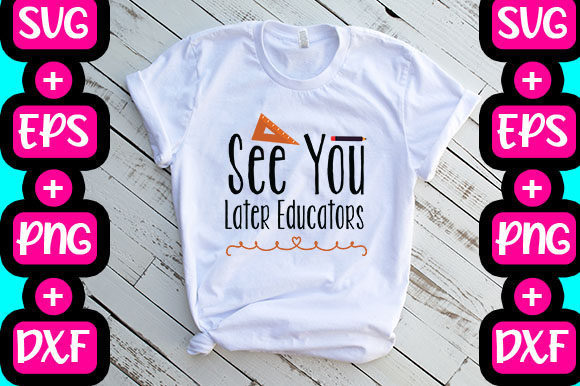
See You Later Educators
A Designer’s First Look: Charm with Clear Intent
When See You Later Educators landed in my inbox, I paused—not because it’s flashy, but because it’s quietly confident. It’s not a loud, cartoonish school motif or an overdesigned chalkboard scene. Instead, it’s clean, warm, and human: a friendly farewell gesture wrapped in teacher-appropriate whimsy. The layout feels balanced for embroidery—no sprawling elements that would fight hoop constraints, no fragile stems or hair-thin connectors that vanish under satin stitch. As a machine embroidery design, it leans into readability over ornamentation, which is exactly what makes it work for real projects, not just digital previews.
How It Actually Stitches: From Mockup to Tote Bag Reality
Last week, I stitched See You Later Educators onto a natural canvas tote for a local teacher appreciation pop-up. I used medium-weight cutaway stabilizer, 40-weight polyester thread, and a 4-inch hoop—comfortable space, but not excessive. The design scaled cleanly at 3.8 inches wide, and the lettering held crisp edges without feathering. No re-hooping was needed. That tells me something important: this isn’t just a paper craft graphic repurposed for embroidery—it’s built with stitch logic in mind. The curves flow, the spacing between “See,” “You,” and “Later” gives breathing room for fill stitch, and the educator icon (a subtle apple + clipboard combo) sits at a scale that reads clearly without demanding ultra-fine detail.
Where It Shines—and Where to Pause
See You Later Educators excels on structured, medium-to-heavy fabrics: cotton twill aprons, fleece-lined sweatshirts, linen tea towels, and denim totes. It’s ideal for custom apparel meant to last—think end-of-year gifts for staff, boutique nursery decor, or embroidered patches sewn onto backpacks. On baby onesies? Yes—but only if you reduce the size to 2.5 inches max and use lightweight tear-away stabilizer. Tiny lettering doesn’t always translate cleanly on stretchy knit, so test first.
It’s less ideal for curved surfaces like baseball caps unless you’re using a cap frame and have experience adjusting tension for front-panel stitching. And while the design avoids dense fill areas, I’d still avoid layering it directly over seams or thick fabric folds—those can distort registration. Dark fabric? Absolutely fine—but confirm your thread colors offer enough contrast. A light yellow or cream works beautifully against navy or charcoal, but pale gray on black will disappear without careful testing.
Real-World Fit Across Your Product Lines
- Tote bag design: Strong visual impact at 4 inches; reads well from across a craft fair table.
- Sweatshirt embroidery: Softens nicely on fleece, especially when paired with tonal thread.
- Embroidered patch: Clean outlines mean easy iron-on backing prep and sharp edge definition.
- Baby embroidery: Gentle theme + moderate size = thoughtful, non-cutesy newborn gift.
- Holiday embroidery: Fits seamlessly into “Back to School” or “End of Year” collections—not seasonal, but timely.
- Etsy seller asset: Works as both a finished product (e.g., personalized teacher tote) and a digital embroidery file listing—just verify licensing before offering the file itself.
What It Adds to Your Handmade Product—Beyond the Stitch
There’s a quiet professionalism in See You Later Educators. It doesn’t shout “handmade!”—it whispers competence. Customers notice that. When a parent orders a personalized gift for their child’s favorite teacher, they’re not buying font or clipart—they’re buying recognition, warmth, and respect. This design delivers that without leaning on cliché. It supports brand consistency for small shops that specialize in educator-themed goods, and it elevates giftability: people photograph it, tag your shop, and return for matching items. That kind of trust builds slowly—but starts with choices like this one.
Practical Embroidery Designer Notes
Before cutting fabric or loading your machine:
- Test See You Later Educators on scrap fabric *exactly* like your final project—same weight, same stretch, same dye lot if possible.
- Check thread color contrast in both natural and artificial light. What reads well on screen may fade on dark cotton.
- Review stitch density visually—if the fill looks overly compact in your software, consider reducing density by 5–10% for breathable fabrics.
- Confirm hoop size compatibility. While it fits comfortably in a 4-inch hoop, verify minimum clearance if you’re tight on space.
- Inspect corners and interior negative space. Does the apple stem or clipboard corner hold integrity at your target size? Zoom in.
- Run a black-and-white mockup. If it loses personality in monochrome, it may rely too heavily on color nuance—risky for thread-limited projects.
- Use appropriate stabilizer: cutaway for knits, tear-away for stable wovens, fusible for lightweight linens.
- Double-check license terms. Since this is part of the 20 School SVG Design Bundle, confirm whether commercial use of the embroidery file is permitted before selling finished items or digital assets.
Final Thought: A Design That Serves Its Purpose
See You Later Educators isn’t trying to be everything. It’s a focused, thoughtful piece—like a well-planned lesson plan. It respects the craft, the customer, and the context. For embroidery designers building a reliable library of T-Shirt Designs and Graphics, it fills a specific, valuable niche: warm, professional, classroom-adjacent, and production-ready. Whether you're stitching for your own craft business, fulfilling Etsy orders, or creating small-batch boutique merchandise, this design earns its place—not because it’s trendy, but because it works. Consistently. Quietly. Well.