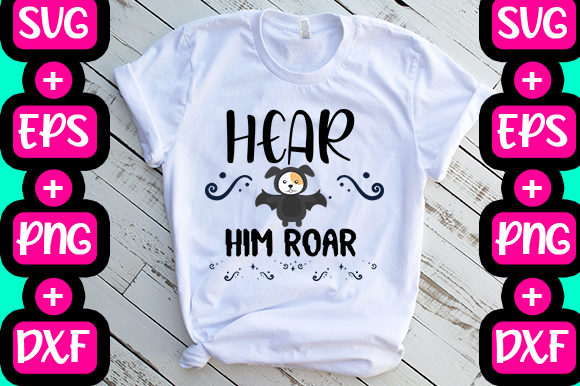
Hear Him Roar
First Impressions: Bold, Playful, and Instantly Recognizable
When I opened Hear Him Roar for the first time, I didn’t see just another Halloween graphic—I saw a confident, rhythmic silhouette with strong negative space and clear visual hierarchy. It’s not overly busy, but it carries weight—literally and emotionally. The lion’s profile dominates, jaw slightly open, mane stylized into bold, flowing curves rather than fussy detail. That balance of simplicity and personality is exactly what makes Hear Him Roar work so well as a machine embroidery design: it translates cleanly from screen to stitch without collapsing or blurring.
A Real Project Test: Embroidering a Linen Tote for a Local Boutique
Last week, I used Hear Him Roar on a natural linen tote bag for a small shop launching their Halloween collection. We chose a 4.5-inch hoop and medium-weight cutaway stabilizer—critical for linen’s slight looseness. The result? Crisp satin-stitched outlines, clean fill-stitch mane sections, and zero thread nesting in the jaw area. Customers responded immediately: “That lion *roars*,” one said—and she was right. Not because it’s loud, but because it feels alive in its restraint. That’s the mark of a well-considered embroidery file: it doesn’t shout to be seen; it earns attention through clarity and intention.
Where Hear Him Roar Shines (and Where It Asks for Thought)
Hear Him Roar excels on stable, mid-to-heavyweight fabrics—think cotton twill aprons, fleece-lined sweatshirts, denim jackets, and structured pillow covers. Its clean lines hold up beautifully in satin stitch, and the open mouth area leaves room for subtle thread shading if you’re layering colors. As a tote bag design or sweatshirt embroidery, it reads at arm’s length and holds up under repeated washing—provided you use quality threads and proper stabilizer.
But here’s where experience kicks in: avoid using Hear Him Roar on ultra-thin baby onesies without significant simplification. The jaw line and inner mane details may not resolve cleanly below 3 inches in height. On stretchy fabric like jersey tees, it’ll need tear-away + cutaway combo stabilizing—and even then, test first. Curved surfaces like caps require careful digitizing adjustments that this SVG/DXF/EPS/PNG package doesn’t include, so treat it as a starting point, not a plug-and-play cap design.
Commercial Use Reality Check for Craft Businesses
If you’re an Etsy seller or small shop owner offering personalized gifts, Hear Him Roar adds instant thematic value to holiday embroidery projects—especially for kids’ items, nursery decor, or playful unisex apparel. It’s versatile enough for a toddler’s tea towel and mature enough for a teen’s backpack patch. But remember: as a digital embroidery file, its commercial viability depends on your license terms. Since the listing states possible uses include vinyl, decals, and paper crafts—but doesn’t specify commercial embroidery rights—verify licensing before bundling it into physical products you sell at craft fairs or online.
Design Assets That Build Trust
Customers notice when embroidery looks intentional—not rushed, not pixelated, not overcrowded. Hear Him Roar supports that perception. Its balanced proportions mean it scales well across sizes: 2.5 inches on a baby bib still reads as “lion,” not “blob.” At 5 inches on a canvas market bag, it anchors the composition without overwhelming. That consistency builds trust—your buyers begin associating your handmade product with polish and care, not just charm.
Practical Designer Notes You’ll Actually Use
- Always test on scrap fabric first—especially with textured weaves or dark backgrounds. Linen, terry cloth, and brushed cotton all behave differently under needle tension.
- Check thread color contrast early. A warm gold against charcoal gray reads rich and autumnal; the same gold on navy can disappear unless you add an underlay stitch or switch to metallic.
- Review stitch density visually. Zoom in on the mane’s outer edge—if fill stitches look cramped or overlapping, reduce density by 5–10% in your embroidery software before stitching.
- Confirm hoop size compatibility. While Hear Him Roar fits comfortably in a 5x7 hoop, some versions may push the limits of a 4x4—measure the bounding box in your editing software before loading.
- Inspect small details in black-and-white mockups. If the open mouth or eye shape loses definition without color, consider simplifying those areas manually for smaller applications.
- Compare light vs. dark fabric backgrounds in printable mockups before listing on Etsy or your shop site. What pops on ivory may vanish on black unless you adjust underlay or stitch order.
- Use proper stabilizer—not just “some.” For woven fabrics: medium cutaway. For knits: cutaway + topping. For towels: heavy cutaway + water-soluble topper.
- Confirm dual-use suitability. If you plan to offer both physical embroidered goods and digital downloads, ensure your license permits both—and disclose clearly to buyers.
Why This Isn’t Just Another Halloween Graphic
There’s a quiet confidence in Hear Him Roar that separates it from trend-chasing clip art. It doesn’t rely on glitter, drop shadows, or excessive layering to feel special. Instead, it leans into rhythm, proportion, and purpose—qualities that serve embroidery first, decoration second. Whether you’re stitching a custom embroidered patch for a school fundraiser, designing a limited-run sweatshirt for your craft business, or prepping a holiday gift bundle for your Etsy shop, Hear Him Roar behaves like a professional design asset: reliable, adaptable, and quietly memorable.
Final Thought: Design With Intent, Not Just Inventory
As a designer who’s reviewed hundreds of embroidery files—from over-digitized florals to under-engineered lettering—I appreciate how Hear Him Roar respects the medium. It doesn’t try to do everything. It does one thing very well: give voice to a moment, a season, a feeling—with stitches that land true. Use it where boldness matters, where clarity counts, and where your customers deserve more than decoration—they deserve design that means something.